EdTech/AI (Graduation Project) · Full-Stack AI Web Application
Smart Study Companion
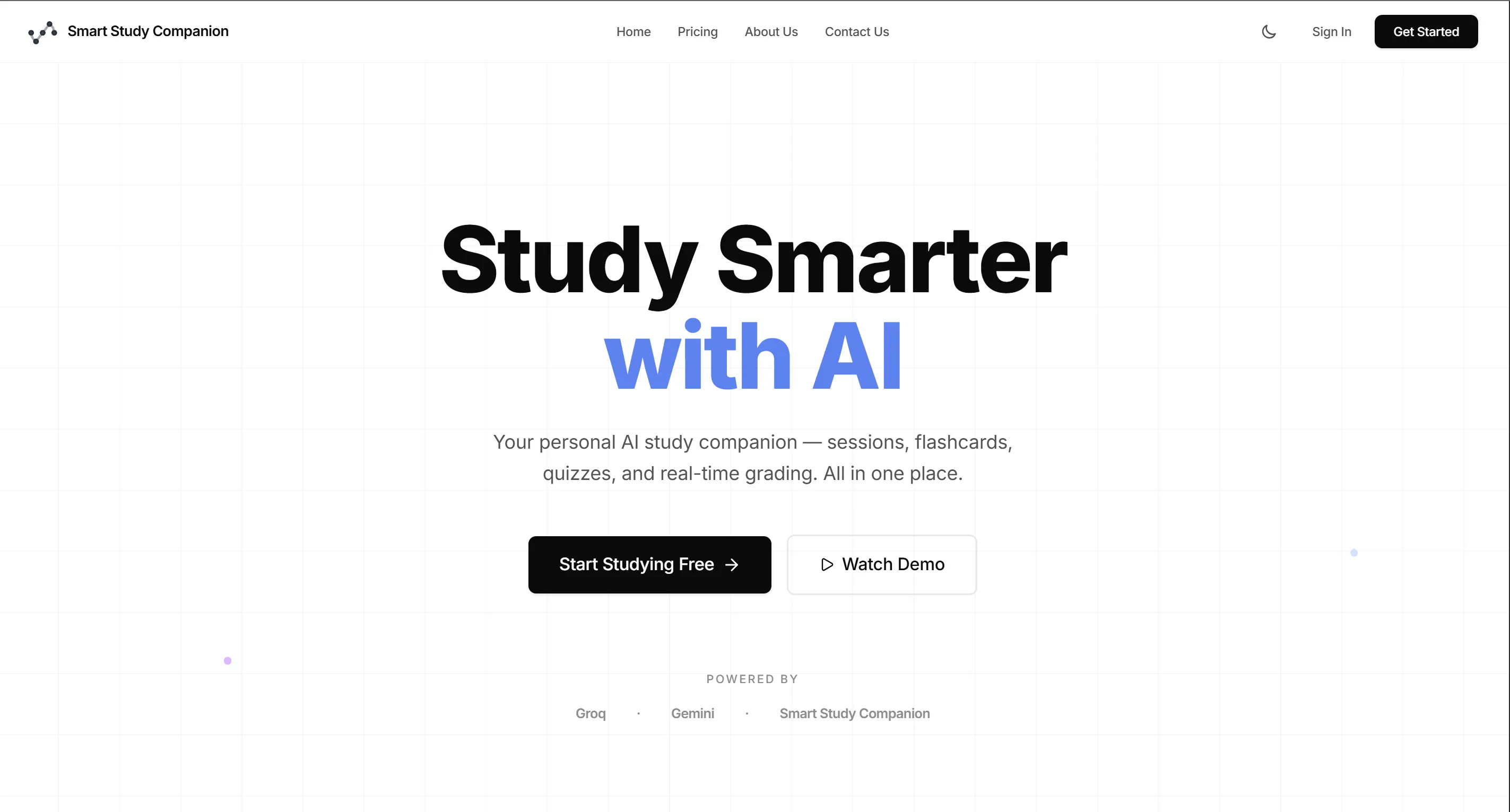
An AI-first educational platform integrating RAG architecture, LLM orchestration, and full-stack development to modernize student study workflows.
Overview
Smart Study Companion is a unified intelligent learning platform that combines study planning, AI-assisted understanding, assessment, and academic tracking into one workflow. Instead of forcing students to move between fragmented apps, it centralizes the full study journey, from course material processing to revision and performance follow-up.
The Problem
University students often struggle to manage schedules, absorb dense course content, and maintain steady progress across multiple subjects. Existing tools are usually split across separate planners, note apps, and quiz systems, increasing context switching and cognitive burden while reducing learning effectiveness.
Key Features
- Retrieval-Augmented Generation (RAG) workflows
- AI syllabus parser to automate setup
- Adaptive quiz generation
- Master schedule planning engine
- Comprehensive GPA tracking
- Hybrid AI orchestration (Groq + Gemini)
Outcomes & Impact
- Built a stable end-to-end system covering major student learning journeys from planning to assessment.
- Improved study efficiency through integrated AI notes, summaries, quizzes, and performance feedback.
- Demonstrated practical deployment readiness for real academic use and institutional scaling.
System Flow & Architecture
Real System Boundaries
1. Frontend is a browser-based SPA responsible for UI rendering, route handling, local state, and authenticated API calls.
2. Backend is a Node.js/Express API that owns business logic, request validation, authentication, AI orchestration, and response formatting.
3. MongoDB stores persistent domain data (users, courses, GPA inputs, session history, and generated study artifacts metadata).
4. AI providers are external dependencies invoked by backend services, not directly by the frontend.
Backend Internal Architecture
End-To-End Data Flows
Authenticated Read Flow
AI Learning Flow
Security And Trust Model
1. Authentication uses JWT with client-side token storage.
2. Frontend sends token through request headers (x-auth-token) via API layer.
3. Protected routes enforce identity in backend middleware before controller execution.
4. AI and external API keys are server-side only and loaded from environment variables.
Why This Architecture Works
1. Clear separation of concerns: UI, API/business logic, and persistence are independently evolvable.
2. Service layer centralizes complex logic (GPA math, AI prompting, parsing) for reuse and testing.
3. External AI providers are abstracted behind backend endpoints, allowing provider changes without frontend rewrites.
4. Feature growth is manageable because frontend and backend are both organized by domain modules.